Bearable is genuinely good at what it does. You can track mood, symptoms, sleep, medication, energy, pain -- all of it in one place, with correlation charts that actually try to connect the dots. For people managing chronic illness or just trying to understand what makes them feel worse or better, it's one of the more thoughtful apps in this category.
Then you hit the free tier wall.
Not a paywall in the usual sense. More like a fog. You can keep logging, but your history starts disappearing from view after 30 days on the free plan. The thing that makes symptom tracking valuable, seeing patterns over months, is exactly the part that requires a subscription.
What Bearable actually costs
I'm going off their current pricing, not memory. Bearable Premium runs $34.99 a year or $6.99 a month, with a 7-day free trial. That's the verified number as of 2026.
The free tier does work. You can log symptoms, track mood, see weekly reports, use a customizable graph. There's genuine value in the free version and I'd rather say that plainly than pretend it's broken.
What the free tier locks:
- Your full history (free tier shows the last 30 days)
- Correlation reports connecting symptoms to activities or sleep
- Unlimited Goals and custom Experiments
- All historical data access beyond the 30-day window
The 30-day wall
This is the one that actually gets people. Mood and symptom tracking is a long-game tool. You're trying to catch whether that dip every Thursday is correlated with your Wednesday night sleep. Whether the new medication is actually doing anything over six weeks. Whether stress patterns shift across months.
Thirty days of history isn't long enough to see most of that. So the free tier gets you into the habit of logging, then takes away the reason you started logging in the first place.
That's the moment people start looking for alternatives.
SoulSync: the honest comparison
I built SoulSync because I wanted a mood and journal app where the full feature set was just the app. No tier to unlock. I've written about the broader philosophy in why mental-health tracking behind a subscription is backwards, but the short version: the part that helps you is seeing your own patterns. That shouldn't cost a monthly fee to access.
SoulSync is React Native and Expo, GPL-3.0 licensed, 333 passing tests, and Android only for now. Every entry lives in a SQLite database on your phone. Photos too. No account, no cloud backup, no server anywhere. Your history doesn't disappear after 30 days because nothing's storing it anywhere but your device.
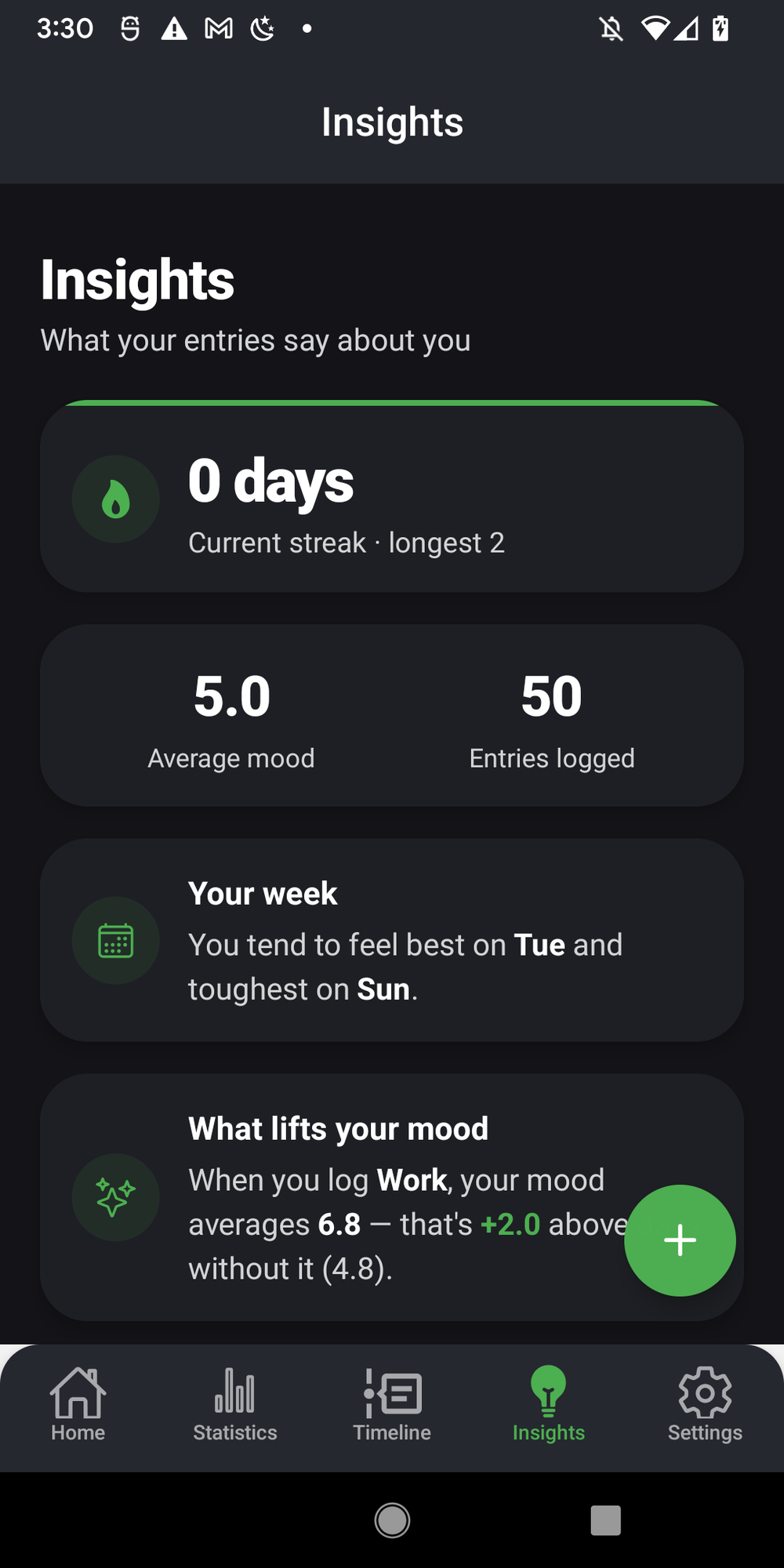
Here's the side by side. Numbers verified against current listings:
| SoulSync | Bearable | |
|---|---|---|
| Price | Free (open source) | Free tier; Premium $34.99/yr or $6.99/mo |
| Full history access | Unlimited, always | 30 days on free tier |
| Mood tracking | Included | Included (free) |
| Correlation analysis | Basic patterns, included | Full correlation reports are Premium |
| Journal / notes | Included | Included (free) |
| Data export | JSON, included | Available |
| Data stored on device | Yes (SQLite, fully local) | Encrypted backup to Google Cloud EU |
| Open source | Yes, GPL-3.0 | No |
| Platforms | Android (free APK) | Android and iOS |
| Symptom-specific tracking | Custom fields, mood focus | Detailed symptom + medication logging |
What you give up
I want to be fair about this. Bearable is more fully-featured for people tracking complex chronic illness stuff: medication schedules, pain levels, specific symptom categories, detailed experiments. If you're managing something with multiple variables and want granular correlation tools, Bearable Premium is a serious product built for that.
SoulSync's focus is mood and journal entries. It's not a symptom tracker in the medical-management sense. If you need to log dosage against pain levels and correlate them over 90 days, it's not the right tool.
But if you want to track your mood, see your patterns, write journal entries, and have access to all of it indefinitely without paying anything, SoulSync covers that completely. And if you're on Android and have any concern about what happens to sensitive mental health data in the cloud, the local-first architecture removes a whole category of worry. I wrote more about that in a mood tracker shouldn't need an account or the cloud.
On the privacy question
Worth being specific here rather than vague.
Bearable encrypts your data on device before backing it up to Google Cloud servers in the EU. They say they don't sell personal data and don't share it with third parties unless you opt in (to something like Google Fit). That's a real effort, and I'm not going to claim otherwise.
But it's still your mood data on someone else's infrastructure, under a company's privacy policy that can change. The data exists in a cloud bucket somewhere. For most people that's fine. For some people, specifically the people tracking mental health, sleep, and symptoms, that's a meaningful distinction.
SoulSync's architecture is different by design. The data is an SQLite file on your phone. There's no server to breach because there isn't one. The privacy claim in the README isn't a policy, it's a structure. You can read the code and verify it, because the code is public.
That's not a criticism of Bearable's approach. It's just a different tradeoff, and it's worth knowing which one you're choosing.
If you want to try it
SoulSync is Android only. Download the APK from the latest GitHub release and install it directly. No Play Store account required, no signup, no email. Log your first entry and see if it fits.
The full product page is at raeduslabs.com/soulsync if you want more detail before installing. The repo is github.com/Antimatter543/mood-tracker if you want to read the code first.
If you've been using Bearable free and hit the 30-day wall, this solves exactly that problem. Whether the tradeoffs work for you depends on what you're tracking, but the history part isn't one of them.
If you've been comparing against Daylio specifically, I also wrote a direct Daylio comparison with different feature details.